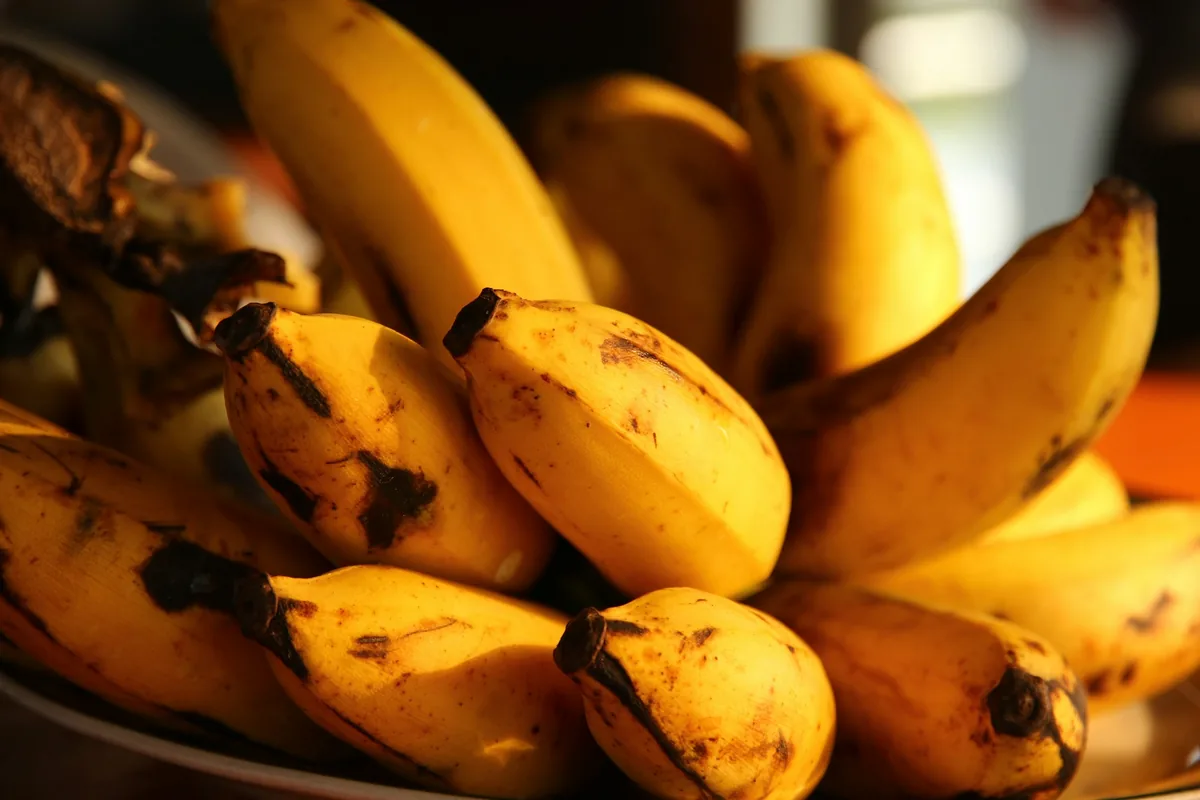
Are bananas the richest source of potassium?
Bananas are a good source, but they aren't the richest. A serving of dried apricots, cooked lentils, a baked potato or canned kidney beans provides more, as the food table shows.
Potassium is the main mineral inside your cells, keeping the electrical gradient that nerves, muscles and your heart rely on, and it works closely with sodium1.
Your body needs potassium for nerve transmission2.
Maintains the electrical gradient across cells that muscles need to contract1.
Higher intakes may help lower blood pressure, partly by increasing sodium loss in urine1.
Maintains fluid volume inside cells, while sodium governs fluid outside them1.
Helps control the body's acid-base balance3.
| Food and serving | Amount |
|---|---|
| Apricots, dried, ½ cup | 755 mg |
| Lentils, cooked, 1 cup | 731 mg |
| Potato, baked, flesh only, 1 medium | 610 mg |
| Kidney beans, canned, 1 cup | 607 mg |
| Banana, 1 medium | 422 mg |
| Milk, 1%, 1 cup | 366 mg |
| Spinach, raw, 2 cups | 334 mg |
| Yogurt, fruit, nonfat, 6 oz | 330 mg |
| Food and serving | Amount |
|---|---|
| Chicken breast, grilled, 3 oz | 332 mg |
| Salmon, Atlantic, farmed, cooked, 3 oz | 326 mg |
Whole-wheat flour and brown rice are much higher in potassium than refined white flour and white rice1. Amounts per serving from1.
Many salt substitutes swap some sodium chloride for potassium chloride; people with kidney disease should check first1.
The same reference table draws the reference lines on your charts in Ayuvo. Needs differ in pregnancy and breastfeeding, which are not covered here.
| Age | Women | Men |
|---|---|---|
| 19–30 | 2,600 mg | 3,400 mg |
| 31–50 | 2,600 mg | 3,400 mg |
| 51–70 | 2,600 mg | 3,400 mg |
| 71+ | 2,600 mg | 3,400 mg |
AI (Adequate Intake) is used when there is not enough evidence for an RDA: an amount assumed to be enough. Per day, for adults14.
Signs like these have many possible causes. They are a reason to talk to a clinician, not to self-treat.
Getting too little potassium can raise blood pressure, deplete calcium in bones and increase kidney stone risk2.
Potassium from food isn't harmful with healthy kidneys, but kidney disease or some medicines can lead to high blood potassium2.
Blood potassium is closely regulated and often reflects body stores poorly, since most potassium is inside cells1.
| Serum potassium | What it may mean |
|---|---|
| < 3.6 mmol/L | Low (hypokalemia) |
| 3.6–5.0 mmol/L | Normal range |
| > 5.0 mmol/L | High (hyperkalemia) |
Labs use different units and ranges. Your clinician reads a result alongside your history and other tests.
Most supplements contain only small amounts of potassium, and the label lists elemental potassium1.
The most common form in supplements, also used in salt substitutes1.
Citrate, phosphate, aspartate, bicarbonate and gluconate are also used; none is proven better2.
Present in microgram amounts as a source of iodine, not potassium1.
Supplements can interact with medicines. Talk to a clinician or pharmacist before you start one, especially at high doses.
Bananas are a good source, but they aren't the richest. A serving of dried apricots, cooked lentils, a baked potato or canned kidney beans provides more, as the food table shows.
Many manufacturers keep amounts low because some potassium chloride medicines have been linked with small-bowel injuries. Food is the main way most people get potassium.
People with chronic kidney disease, and people taking medicines such as ACE inhibitors, angiotensin receptor blockers or potassium-sparing diuretics, can build up too much potassium even from typical food intake. They should ask a clinician before using potassium supplements or salt substitutes.
Ayuvo charts potassium by day, week, month and year, with the reference lines from this page, personalised by age and sex where they differ. Supplements you log in Medications count too. Free, with no account.
Or read the code: Ayuvo is open source
Facts on this page come from these sources, checked on the dates shown. Intake numbers come from Ayuvo's shared reference table, which cites the sources marked for them.
General information, not medical advice. This guide is for healthy adults and does not cover pregnancy, breastfeeding, children or medical conditions. It cannot diagnose or treat anything. Talk to a clinician before starting high-dose supplements, or if you think you may have too little or too much of a nutrient. Spotted an error? Email us.